
Our Curriculum
The Montessori Curriculum Areas at Idealnest Early Years
At Idealnest Early Years, our approach to early childhood education is grounded in the Montessori method, which emphasizes hands-on, self-directed learning through the use of carefully designed materials. Our child-centered philosophy empowers children to explore and develop skills at their own pace, fostering independence, concentration, and a lifelong love of learning.
We utilize Montessori didactic materials across the following five key curriculum areas:
The Montessori Curriculum Areas at Idealnest Early Years
At Idealnest Early Years, our approach to early childhood education is grounded in the Montessori method, which emphasizes hands-on, self-directed learning through the use of carefully designed materials. Our child-centered philosophy empowers children to explore and develop skills at their own pace, fostering independence, concentration, and a lifelong love of learning.
We utilize Montessori didactic materials across the following five key curriculum areas:
01

Practical Life
Practical Life activities are foundational to Montessori education. They help children develop fine motor skills, hand-eye coordination, and a sense of independence. At Idealnest, children engage in everyday tasks such as pouring, buttoning, sweeping, and tying shoelaces, which instill a sense of responsibility and self-reliance.
- Skills Developed: Concentration, coordination, independence, and order.
- Activities Include: spooning, pouring, polishing, dressing frames.
- Purpose: These tasks prepare children for real-life activities while simultaneously helping them refine movement and attention to detail.
01
Practical Life
Practical Life activities are foundational to Montessori education. They help children develop fine motor skills, hand-eye coordination, and a sense of independence. At Idealnest, children engage in everyday tasks such as pouring, buttoning, sweeping, and tying shoelaces, which instill a sense of responsibility and self-reliance.
- Skills Developed: Concentration, coordination, independence, and order.
- Activities Include: spooning, pouring, polishing, dressing frames.
- Purpose: These tasks prepare children for real-life activities while simultaneously helping them refine movement and attention to detail.
02

Sensorial
The Sensorial area helps children explore and categorize their sensory experiences—touch, sight, sound, taste, and smell. Montessori materials in this area are designed to isolate each sense, allowing children to focus on specific qualities such as color, shape, texture, size, and sound.
- Skills Developed: Observation, discrimination, and classification.
- Activities Include: Color tablets, geometric solids, sound cylinders, pink tower etc.
- Purpose: Sensorial materials sharpen the child’s ability to make precise distinctions, enhancing cognitive development and preparing them for more advanced subjects such as mathematics and language.
02
Sensorial
The Sensorial area helps children explore and categorize their sensory experiences—touch, sight, sound, taste, and smell. Montessori materials in this area are designed to isolate each sense, allowing children to focus on specific qualities such as color, shape, texture, size, and sound.
- Skills Developed: Observation, discrimination, and classification.
- Activities Include: Color tablets, geometric solids, sound cylinders, pink tower etc.
- Purpose: Sensorial materials sharpen the child’s ability to make precise distinctions, enhancing cognitive development and preparing them for more advanced subjects such as mathematics and language.
03

Mathematics
Montessori math materials transform abstract concepts into tangible, hands-on learning experiences. Beginning with concrete activities like counting beads and learning number sequences, children gradually move toward understanding abstract mathematical operations.
- Skills Developed: Number recognition, counting, addition, subtraction, multiplication, and division.
- Activities Include: Number rods, golden beads, the spindle box, decimal system etc.
- Purpose: The goal is to help children understand math concepts through sensory experiences, making mathematics logical and engaging.
03
Mathematics
Montessori math materials transform abstract concepts into tangible, hands-on learning experiences. Beginning with concrete activities like counting beads and learning number sequences, children gradually move toward understanding abstract mathematical operations.
- Skills Developed: Number recognition, counting, addition, subtraction, multiplication, and division.
- Activities Include: Number rods, golden beads, the spindle box, decimal system etc.
- Purpose: The goal is to help children understand math concepts through sensory experiences, making mathematics logical and engaging.
04

Language
Language in Montessori goes beyond reading and writing—it encompasses all aspects of communication. Through a carefully structured progression, children at Idealnest develop vocabulary, phonetic awareness, and eventually begin reading and writing. The Montessori materials also support grammar and sentence structure as the child grows.
- Skills Developed: Vocabulary expansion, phonics, reading, and writing.
- Activities Include: Sandpaper letters, movable alphabet, object boxes, and storytelling.
- Purpose: Language activities are designed to develop fluency and expression, supporting children’s communication skills and confidence.
04
Language
Language in Montessori goes beyond reading and writing—it encompasses all aspects of communication. Through a carefully structured progression, children at Idealnest develop vocabulary, phonetic awareness, and eventually begin reading and writing. The Montessori materials also support grammar and sentence structure as the child grows.
- Skills Developed: Vocabulary expansion, phonics, reading, and writing.
- Activities Include: Sandpaper letters, movable alphabet, object boxes, and storytelling.
- Purpose: Language activities are designed to develop fluency and expression, supporting children’s communication skills and confidence.
05
Cultural Studies
Cultural Studies encompass subjects like geography, history, biology, and science. Through exploration of the world around them, children are introduced to the natural environment, cultural diversity, and scientific principles, encouraging a sense of curiosity and respect for the world.
- Skills Developed: Knowledge of the natural world, cultural awareness, and scientific inquiry.
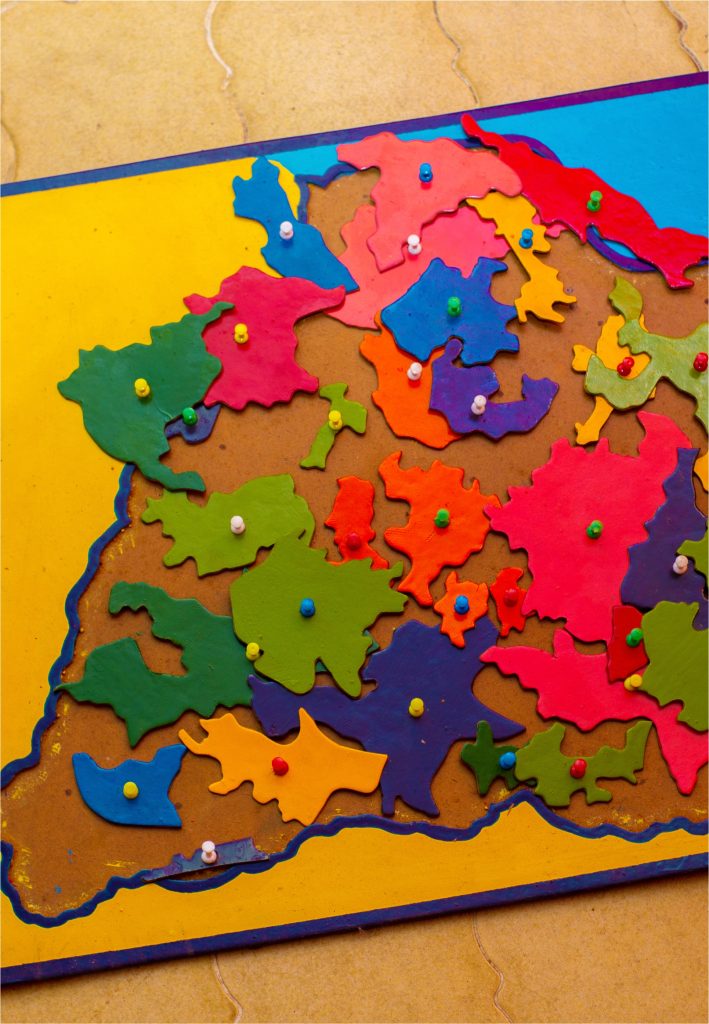
- Activities Include: Puzzle maps, life cycle charts, land and water forms, and nature walks.
- Purpose: Cultural Studies broaden the child’s understanding of the world, promoting a global perspective and a deep respect for life, nature, and different cultures.
05
Cultural Studies
Cultural Studies encompass subjects like geography, history, biology, and science. Through exploration of the world around them, children are introduced to the natural environment, cultural diversity, and scientific principles, encouraging a sense of curiosity and respect for the world.
- Skills Developed: Knowledge of the natural world, cultural awareness, and scientific inquiry.
- Activities Include: Puzzle maps, life cycle charts, land and water forms, and nature walks.
- Purpose: Cultural Studies broaden the child’s understanding of the world, promoting a global perspective and a deep respect for life, nature, and different cultures.